
Month : January 2027
Location : Bali
Time : –
Introduction
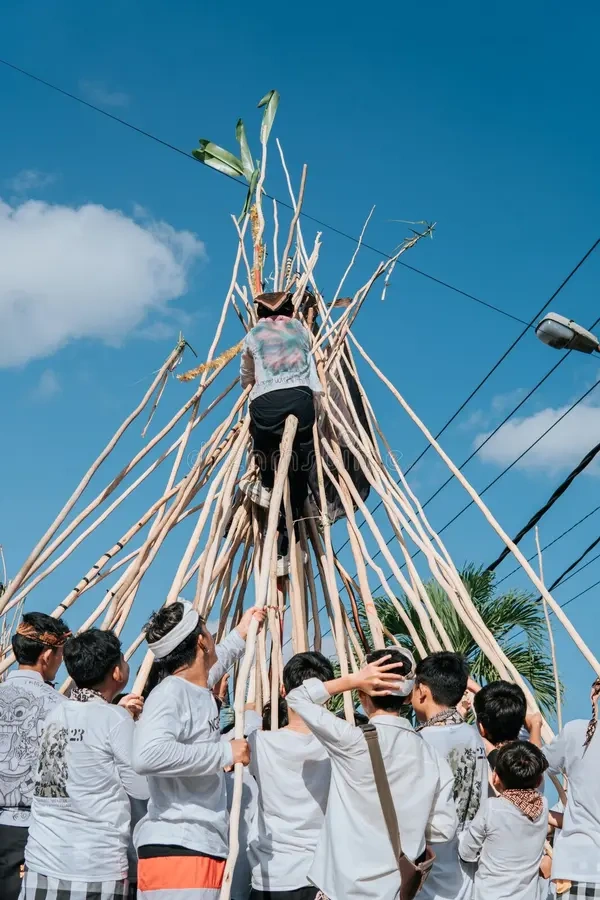
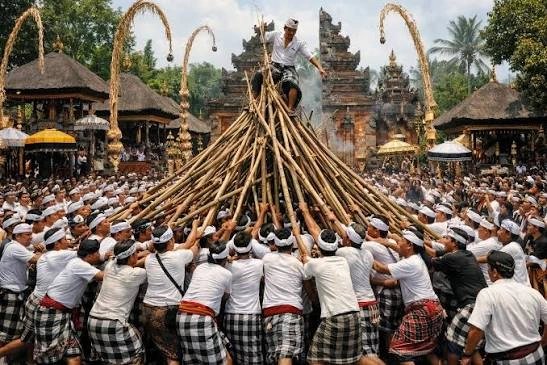
Every Kuningan day, hundreds of long wooden poles meet above the streets of Munggu Village, creating towering shapes and a repeated tek, tek, tek sound. This is Mekotek, also known locally as Ngerebeg, a tradition found specifically in Munggu in Bali’s Badung Regency. Participants carry poles of pulet wood through the village before joining them into cone-like formations. Some climb above the structure as groups push, turn, and test their collective strength. The spectacle is energetic, but its meaning is spiritual and communal. Mekotek is performed to seek protection, ward off misfortune, honour inherited history, and unite the village. Held every 210 days on Kuningan, it shows how one community can preserve a distinctive identity within the wider rhythm of Balinese Hindu life.
Historical Origins
Munggu’s oral history connects Mekotek with the era of the Mengwi Kingdom. According to village tradition, soldiers from Munggu took part in a military expedition linked to the kingdom’s interests in Blambangan, East Java. Mekotek came to commemorate their courage and safe return.
Local accounts place the tradition around the early eighteenth century and associate it with the rule of a Mengwi king remembered as Cokorda Nyoman Sakti Munggu. As with many traditions transmitted across generations, exact dates and historical details vary. The victory narrative should therefore be understood as the community’s inherited account rather than a fully documented military history.
The ceremony was originally said to use spears or other weapons. During Dutch colonial rule, authorities prohibited the practice because they feared it could encourage resistance. Village tradition holds that disease then spread through Munggu, leading residents to seek permission to revive the ceremony. Spears were replaced with wooden poles, which remain in use today.
Mekotek received national recognition as Indonesian intangible cultural heritage in 2016, strengthening efforts to document and preserve it.
Mythology or Religious Significance
Mekotek is performed as a tolak bala tradition, seeking protection from illness, disaster, and disruptive forces. It also honours the village’s ancestors and the memory of those associated with Munggu’s historical defence.
The gathering of many individual poles into one structure provides a powerful image of unity. A single pole has limited strength, but hundreds brought together can form a stable and imposing shape. For the community, this represents cooperation across Munggu’s customary neighbourhoods and generations.
The poles may be decorated with pandan leaves and a tamiang, the round woven symbol also seen in Kuningan offerings. These evoke weapons and shields while giving the practice a protective ceremonial meaning.
Because Mekotek takes place on Kuningan, it is connected to the wider holy day of ancestral farewell and blessing. Yet it is not a standard Kuningan ritual across Bali. It belongs specifically to the people and customary traditions of Munggu.
How the Celebration Evolved
The most important historical change was the replacement of spears with pulet wood. This allowed the ceremony to survive colonial restrictions while transforming its visual and physical form.
Modern roads, traffic, and larger crowds have required greater organisation. Village authorities, customary security officers, and local government now help manage routes and spectator areas. Documentation, cultural research, and heritage recognition have also given Mekotek a wider public audience.
Tourism has encouraged performances inspired by Mekotek outside the sacred occasion, including staged dance or theatrical interpretations. These presentations can introduce the story to visitors, but they should not be confused with the living Ngerebeg Mekotek ceremony performed by the Munggu community on Kuningan.
Despite growing attention, the tradition remains locally owned. Its continuity depends upon village participation rather than outside spectators.
Mekotek takes place every Kuningan, following the 210-day Pawukon calendar. Participants gather after completing their Kuningan prayers and prepare for a procession through the customary village territory.
Men and boys from Munggu’s banjar carry long poles, commonly around two to three and a half metres in length. The groups move through the village, stopping at important junctions where the poles are brought together. Their contact creates the distinctive sound from which the name Mekotek is commonly said to derive.
The poles form a tall cone or pyramid. A participant may climb upwards while the groups below push and move the structure. Different formations may approach one another in a controlled contest of energy and cooperation.
Prayer at village temples forms part of the wider sequence. The procession follows a route carrying religious and historical meaning for the community before participants return to complete the observance.
Traditions and Rituals
Each participant contributes one pole, reinforcing the idea that collective strength depends upon individual responsibility. The pole is not treated simply as sporting equipment. Its material, decoration, and use belong to the inherited ceremonial practice.
The physical contact between poles creates sound, movement, and a temporary structure resembling a mountain or defensive formation. Intersections are significant points along the route because Balinese villages often understand crossroads as places where different energies meet.
Mekotek also brings together Munggu’s customary neighbourhoods. Preparation, route management, prayer, and participation require cooperation across the village. Younger generations learn not only the physical technique, but also the history, discipline, and responsibilities attached to it.
Although the event may appear chaotic, it follows local leadership and established patterns. Participants understand how to gather, move, and release the poles, while organisers work to protect both the ceremony and those nearby.
What Visitors Can Expect
Mekotek is loud, crowded, physical, and fast-moving. Visitors may see hundreds of participants carrying poles through Munggu, accompanied by spectators and customary security officers. The most dramatic moments occur when poles gather into a towering formation.
The event takes place on public village roads, but viewing space can be limited. Sudden movement is part of the ceremony, and a position that appears safe may quickly become part of the participants’ route. Spectators must follow local instructions without hesitation.
Munggu lies in Mengwi District, between the broader Canggu and Tanah Lot areas. Travel from Ubud or Tegallalang can take considerable time, particularly on Kuningan when roads across Bali are busy. Tejaprana guests should confirm the current timing and transport plan before deciding to attend.
Visitors should remember that Mekotek is not a general Bali attraction offered on request. It occurs only according to Munggu’s ceremonial calendar and belongs first to the village community.
Travel Tips
- Check the Kuningan date and confirm the current start time with an official or reliable local source.
- Arrive early because roads in and around Munggu may close or become congested.
- Wear modest clothing and comfortable closed shoes.
- Remain behind any designated boundary and follow instructions from pecalang and organisers.
- Keep well clear when participants begin joining or moving the poles.
- Never touch, hold, or climb a pole unless you are an authorised participant.
- Avoid drones, flash photography, and equipment that obstructs the route.
- Ask before photographing prayers or individual participants at close range.
- Bring water and sun protection, but keep belongings compact in the crowd.
Interesting Facts
Mekotek occurs every 210 days. It is performed on Kuningan according to the Pawukon calendar rather than on a fixed Gregorian date.
Its name is linked to sound. The repeated tek, tek, tek of wooden poles meeting is commonly said to have inspired the name Mekotek.
The poles were once weapons. Village tradition says Dutch colonial restrictions led Munggu to replace spears with pulet wood.
The tradition belongs specifically to Munggu. It is not a ceremony practised by every Balinese village on Kuningan.
Conclusion
Mekotek survives because the people of Munggu continue to give it meaning. Its wooden poles recall an inherited story of courage, but they also express present-day unity, protection, and responsibility. When hundreds of participants bring their poles together, individual effort becomes collective strength. The result is visually dramatic, yet its deepest value lies in the relationships it renews between neighbours, generations, temples, and ancestors. Visitors who witness Mekotek respectfully encounter more than a rare tradition. They see a village actively carrying its history forward, not as a performance from the past, but as a living commitment repeated every Kuningan.
Sources Checked
- Munggu Village Government, “Bendesa Adat Munggu Menerima Kunjungan Tim Kementerian Pendidikan dan Kebudayaan”: https://desamunggu.badungkab.go.id/berita/32452-bendesa-adat-munggu-menerima-kunjungan-tim-kementerian-pendidikan-dan-kebudayaan-bersama-dinas-kebudayaan-kabupaten-badung
- Badung Regency Tourism Information System, “Tradisi Mekotek Desa Munggu”: https://sita.badungkab.go.id/acara/tradisi-mekotek-desa-munggu-sejarah-makna-dan-kemeriahannya
- Putri, N. M. D. Y., “Mekotek Tradition as an Illustration of Social Values and Humanities”, 2026: https://ejournal2.undiksha.ac.id/index.php/GANCEJ/article/view/6221/2155
- Badung Regency Government, “Desa Munggu Gelar Pragmentari Mekotek”: https://badungkab.go.id/kab/berita/3426-desa-munggu-gelar-pragmentari-mekotek-angkat-potensi-budaya-dukung-munggu-sebagai-desa-wisata